
Sunday, June 9, 2013
Update on compost system
A new compost pile was started 3 weeks ago with donkey and goat bedding. Some dry bedding was added on top a week ago. Today, I measured the temperature inside the pile: 100F. Not bad. This means the forced air system appears to be working.


Saturday, March 30, 2013
Corn starts
I planted corn starts a week ago and put them under a row cover. Despite a few frosty nights, they survived and are growing. So, We'll plant another bed of vegetables today.
With a row cover, mid-march seems to be a good planting date.
Baby Goats!
Our baby Nigoras were born yesterday afternoon. they spent the night in the barn, with a small electric heater keeping them warm. They are doing well today. The mother needs to be sheared.

Thursday, February 14, 2013
Grow Light Informations
Photosynthesis does not use all the Sun's light, but only the extremes of the visible spectrum, blue and red. The center of the spectrum, green, is reflected by the plants, which gives them their color. The blue wavelength promoted leaf growth, while the red, stem growth. For starts, leaf growth is what matters, since the seedlings are exhausting the seed food reserve to grow leaves and produce photosynthesis.
The light spectrum of the grow light is therefore important. I made some research on the lights I bough.

There isn't enough energy in the short wavelengths. The grow light setup currently has 2 tubes, and will soon have 6 tubes in a 3x2 setup, with ~ 2-3 inches separation between each fixture. That gap is enough to fit a line of blue LEDs in between and gives a useful boost.
Here are the full specifications on the Ecolux lights used in my setup:
Next step will be the design of the LED lights.
The light spectrum of the grow light is therefore important. I made some research on the lights I bough.

There isn't enough energy in the short wavelengths. The grow light setup currently has 2 tubes, and will soon have 6 tubes in a 3x2 setup, with ~ 2-3 inches separation between each fixture. That gap is enough to fit a line of blue LEDs in between and gives a useful boost.
Here are the full specifications on the Ecolux lights used in my setup:
- Part#=49893
- Initial lumens=1900
- Color temperature=3100K
- Color rendering index=90
Next step will be the design of the LED lights.
Sunday, February 10, 2013
Grow Light Setup, Finally!
Today I got a grow light setup installed in the garage. I used two GE Ecolux T12 tubes, and a 4Ft 2-light shop light fixture. It is barely wide enough for the trays, and I may have to add a second fixture. The shelf is wide enough to set the trays lengthwise, so by setting three 2-light fixtures (6 tubes), I could have 4 to 5 trays in there. Each tube is 40W, so that would suck 240W. We will see how the single fixture works with those spindly beans first, if they survive, then I may go for a 6-tube setup. For now I use a timer, and will keep the lights on during the day, but with a 6-light fixture, I would use a light sensor to turn the lights off when daylight is strong enough.
This is my first grow light setup, and it is exciting!

Looking online in the "medicinal" industry, I see numbers between 1500 and 3000 lumens/sqft for indoor only plants. In this setup, the starts are next to a South facing window, and get a boost in lumen and spectrum a few hours every day.
A seedling tray is 1.4sqft, and therefore needs between 2000 and 4000 lumens.
Each fluorescent tube is 1900 lumens. The growing setup must have between 1 and 2 tubes per tray. The current setup is on the low side. A setup with 3 fixtures, 6 tubes, for 4 trays, would be adequate.
If the current setup gives satisfying results, then I will install a 6-tube setup with 4 trays.
Wednesday, January 23, 2013
Goat Health & Hay
We just passed through a tough cold spell for the goats, with the snow covering the pasture for more than a week. This is the condition that made the goats sick last winter. This time, one of our goats got a mild case of diarrhea again (the Nubian), but seems to be OK. The goats are liking the home made hay, but I did not harvest enough of it. I would need two to three time the amount I collected. Still, some money has been saved harvesting that hay.
As the weather is warming, the goats should need less hay soon. Good because I am running out.
Sunday, January 6, 2013
Another Loss in the Corral
While feeding the chickens this morning, I found a dead hen. Since the body was complete, I doubt it was killed by a predator. This is the second hen to dies this winter. Those hens are 3 years old, so this may not be too surprising.
Sunday, November 11, 2012
Grounding issues
Some weird problem with one of my showers in our house. There is a 50mV to 60mV DC voltage on the showerhead, while the pipe it connects to is properly grounded (a teflon tape appears to isolate the showerhead from the pipe). It is DC, not AC, like the house mains electrical. It is a low voltage (1/1000th of normal AC voltage at the outlets) but is enough to produce some twiching when touched. When all the breakers are off, there is still ~ 15-30mV residual voltage. When the breakers are back on, but the phone wires are disconnected in the phone interface box, there is a ~ 15mV residual DC voltage on the showerhead. When both main electrical and phone are disconnected, there is still a residual DC voltage of 15 - 30mV. There is never any AC voltage. The hot water pipe is grounded to the cold water pipe at the water heater. All voltages were measured with the negative of the voltmeter connected to earth (round prong of a 3-prong outlet). Our wireline phone has a constant humming sound which is very annoying (symptomatic of a bad ground). We actually discontinued the service due to poor audio quality. I am thinking the house has a weak grounding rod, maybe due to corrosion. A google search points to other people experiencing such problems. The recommended solution is to separate the phone interface box ground from the house AC mains ground, although I was told that codes require a common ground, which I tend to agree with, a good ground should have 0 potential on it.
Rainwater, and compost.
The first flush diverters on the rain water system were left open yesterday. We had several frosty mornings in the past few days. If the diverters are allowed to freeze, they will bust, so rain water collection is stopped at this time.
I also got a compost thermometer yesterday to measure the temperature inside the compost heap. It was the same temperature as the outside air, in the 40s, which indicated the forced air system is not really working. I will devise a way to put a much stronger fan in the system.
Sunday, October 28, 2012
Chicken Feed: Protein yield
Yesterday I posted a small analysis of growing our own chicken feed for a flock of 25 chickens. I used corn, peas and sunflowers, and found big differences in yield per acre. It would be interesting to calculate the protein yield per acre instead of the whole yield and compare.
| Crop | Yield per acre | Protein Content | Protein Yield |
| Corn | 6000lbs | 10% | 600lbs |
| Barley | 3600lbs | 13% | 450lbs |
| Peas | 2400lbs | 18% | 400lbs |
| Wheat | 3000lbs | 18% | 500lbs |
| Comfrey | 200,000lbs | 20% | 40,000lbs |
| Sunflowers | 1200lbs | 25% | 300lbs |
| Lentil | 600lbs | 30% | 200lbs |
| Shorgum | 3000lbs | 10% | 300lbs |
All yields are close, except the incredible Comfrey (are those numbers real?). The numbers are for Russian Comfrey, which should grow well in the PNW. It is a heavy nitrogen feeder. It is a perennial that will produce at full yield starting the 3rd year, once the deep tap roots are well established. It can be cut every 5 weeks during the season. It is also difficult to eradicate once established. One option would be to plant it directly inside the chicken run, and protect each plant, then let the chickens feed on one plant at a time.
I may plant at leat 5 plants in the chicken run next year, and protect them the first year to allow them to grow to maturity, then use them as feed supplement.
Aside from Comfrey, we can see that protein yield per acre is a lot more constant that whole yield, and should actually be the main criteria for selecting a crop. Corn, barley and peas seem to be the winners, while sunflower can still be planted as an ornamental while providing some additional proteins.
Saturday, October 27, 2012
Eggs for income?
We stopped at a food stand this afternoon, and I saw eggs at $6.50 a dozen. Wow, prices have gone up! This got me thinking, would it be worth to sell eggs, in a situation where I would need to supplement my income (such as retirement for example)? Assuming $5 a dozen and customers for them, 25 layers, 2 dozens a day, for $300 a month. The only cost is feed, and that alone may eat up a lot of the revenue. What about growing my own feed, since I do have good land?
From a study:
"Feed consumption and its efficient utilization is one of the major concerns in commercial table egg production as feed cost is one of the major components of total cost of production. Feed alone may contribute from 60 to70% to the total cost of production in egg type layers according to Mian (1994) and Qunaibet et al (1992). Better utilization of feed and avoiding unnecessary feed wastage could be the leading factors in minimizing total cost of production (Elwardany 1998). A layer requires 2.5 kg of feed for 1 kg eggs produced (Ascard et al 1995). Elwardany et al (1998) reported a daily feed intake of 102 g over a 52 weeks production period and 2.07 kg feed/dozen eggs laid. Petek (1999) reported a daily feed consumption/layer (115 g)."
Since our layers are free range, they will eat a lot more feed than caged, at least 30% more if I recall previous readings. So the 2Kg/dozen translate into 5lbs/dozen. Our need would then be 10lbs a day for two dozen eggs, which is a little more than what we actually use, so a good round number for a conservative estimate. Assuming a little less feed needs in the winter, due to less egg laying, the total yearly feed need for 25 chickens is about 2500lbs. This already seems a very big number.
What to plant? Layer feed must have about 18% protein content.
- Corn (10% protein)
- Barley (13% protein)
- Peas (18% protein)
- Wheat (18% protein)
- Comfrey (20% protein)
- Sunflower (25% protein)
- Lentil (35% protein)
First formula: 25% Sunflowers, 25% peas 25% corn and 25% commercial formula. The commercial formula will be bought on demand. The rest will have to be grown, dried and stored. I will need about 600lbs of each ingredients. Next is to determine the yield.
Corn yield ~ 100 bushels per acre, 60lbs per bushel, or 6000lbs per acre. 0.1 acre needed, or 4400sqft.
Field peas yield ~ 40 bushels per acre. 0.25 acres needed.
Sunflower yield ~ 1200lbs per acre, 0.5 acres needed.
This gives some scary numbers, I don't see myself hand shelling 600lbs of sunflowers after growing and harvesting them on half an acre. We can estimate that we would need one acre of land to provide 100% of the feed needs of a flock of 25 chickens. That seems an enormous amount of land (and work!) for just $300 a month. Clearly, growing vegetables seems a better income maker.
I would still like to grow some of my chicken feed. Some companion planting may be used here, using the corn or sunflowers as stakes for the peas for example, while the peas provide nitrogen to the soil. A good star would be to grow 1/10th acre of corn, and the peas that would grow with it. Before that, I need to try out the crop, so using one or two of the 10x25 garden beds is probably the best approach. One bed could have corn/peas, while the other sunflowers/peas.
Tuesday, October 2, 2012
Dealing with slugs - picking and garter snakes
I decided to try and pick up slugs every morning since they started appearing. The first week, I picked up up to 25 slugs at a time. The second week, 10-15. Now I am on the third week, and I pick one or two occasionally. The newly planted lettuce, spinach, and peas have not suffered from the slugs. It looks like this method of working.
Yesterday night, I also noticed a baby garter snake in the grass. Good to see they reproduce near the garden. Those snakes feed on slug.
Some slugs are too small to be picked, and yet are still very destructive due to their number, so I do rely on their predators as well as picking.
Sunday, September 30, 2012
A weekend Hard Work
Saturday, I started mowing the street side with the week wacker. The grass is leaning on the electric fence and will eventually short it. The weed wacker was getting clogged within a minute, due to the thickness of the grass. After a 1/2 hour of efforts, I decided to go get the sickle, which proved to be a lot more efficient a this task, albeit more physical. I stopped after two hours, 1/3 of the way to the end of the street. Next task was to tape the compost ventilation pipe and fan to limit air leaks. A second ventilation system was set, except the fan, since I was missing an adapter. Next, the solar water heating panel support blocks were set in place and leveled. Finally, the hot tub support beams were set, one was leveled, the second still needs to be leveled.
Sunday started with cutting the grass on the street with the sickle, almost half the way. The grass was then collected, which ended up taking more time than cutting it. The chicken house was cleaned, and some of the grass used for bedding. The goat shed was cleaned too, and grass added as bedding. I passed the mover to finish off the grass that was cut by hand. This too was a hard job. I got help setting the solar panel in place, which allowed me to clean half of the garage, and park the car in there. Finally, the hot tub second beam was leveled, but some adjustment will have to be made on the first beam.
Good progress this weekend.
Sunday, September 16, 2012
Forced Air Compost System
When I visited Cedar Groove Composting 2 years ago, I really liked how they used forced air to provide oxygen inside the compost pile. They use french drain pipes connected to a ducted fan to force air inside the pile.
A normal compost pile will deplete its oxygen within 15mn, then go anaerobic (smelly), or dry up. I noticed with my compost, that the top layer would compost OK, but then, down 4-5 inches, it would be packed and un-composted. I would have to harvest my compost by layers, then let the top layer compost further, etc. It takes forever. Seeds are not killed by this cold composting system, like they would in a hot compost pile, so I get volunteer plants everywhere I spread my compost. I decided to use forced air, like Cedar Groove, but on a smaller scale.
Information is available on line:
Magic Soil
Aerated Static Compost Pile
Here is my system, in pictures. I bought less than $20 of part, and one part (~$3.50) was not used. The fan and solar panel I already had.
The black pipe is 3" corrugated French drain. It has small holes that are the right size to let air out, while limiting the amount of compost going in.

I forgot to wrap the vertical section with duct tape. This section won't be burried in compost, and will let most of the air escape. This will have to be done later.
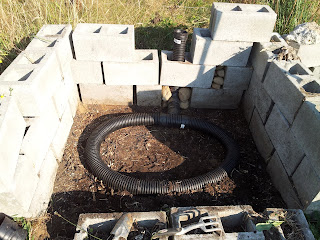


 The fan is not firmly attached to the pipe, so the pressure inside the pipe may not be enough to push the air through the pile. We will see how that works.
A normal compost pile will deplete its oxygen within 15mn, then go anaerobic (smelly), or dry up. I noticed with my compost, that the top layer would compost OK, but then, down 4-5 inches, it would be packed and un-composted. I would have to harvest my compost by layers, then let the top layer compost further, etc. It takes forever. Seeds are not killed by this cold composting system, like they would in a hot compost pile, so I get volunteer plants everywhere I spread my compost. I decided to use forced air, like Cedar Groove, but on a smaller scale.
Information is available on line:
Magic Soil
Aerated Static Compost Pile
Here is my system, in pictures. I bought less than $20 of part, and one part (~$3.50) was not used. The fan and solar panel I already had.
The black pipe is 3" corrugated French drain. It has small holes that are the right size to let air out, while limiting the amount of compost going in.

I forgot to wrap the vertical section with duct tape. This section won't be burried in compost, and will let most of the air escape. This will have to be done later.


Saturday, September 8, 2012

Attila the barn cat
Attila has been a little more assertive lately, coming around the house, and letting us approach him a little closer, about 10FT. Here is a shot of him taken at the end of the day:
 The barn has been free of rodent for a while. Attila, Kaly, and the trapping, have dramatically reduced the rodent population.

Thursday, September 6, 2012
TO-DO Before end of 2012
- Finish pasture sheds (screw loose siding panels).
- Plant cover crop.
- Clean junk along corral.
- Run a load to the waste disposal facility.
- Get a bid on a roof deck and deck beam repair.
- Stain the deck.
- Add forced ventilation to compost (similar to Cedar Groove system).
- Clean up garage.
- Sheetrock garage.
- Build shelves and greenhouse window in garage South wall.
- Remove old electric water heater. Install solar tank. Install new electric water heater.
- Winterize beehives.
Saturday, September 1, 2012

Friday, August 31, 2012
Garter Snake in garden bed
This morning while harvesting Kale for the goats, I surprised a Garter snake hiding under the plants. That is a very good news. Garter snakes eat slugs, and not surprisingly, that bed was devoid of slugs this morning. I will research a bit more about those and see if I can provide them hiding spots and other things they like, maybe rocks exposed to the sun, I know lizards like those to warm up in the morning.
This is another benefit of having the hens contained. They would have made breakfast of that small snake. Where hens roam, the small fauna disappears.
Thursday, August 30, 2012
2012 Accomplishments so far
Sometimes it seems we are fighting a loosing battle, so it is good to look back and see what was accomplished. Here are the accomplishments we have made in 2012:
- Barn clean up. Although there is still to do, the barn is a lot cleaner, particularly thanks to rodent trapping.
- Front Yard cleaning. This was started in late 2011, and is still ongoing. Compared to Summer 2011, the yard is a lot cleaner now.
- First full honey harvest. We harvested one full honey super, which yielded 2 gallons, or about 25 pounds.
- Poultry flock contained. The hens used to escape and roam throughout the property. They are now contained in the corral.
- First garden. The hens used to destroy our garden. Now that they are contained, we grew beets, carrots, salad in the cold frame, kale, cabbage, tomatoes, peppers.
- Installation of a greywater system. Nasturtium, sunflowers and bamboo is growing from the water.
- Kitchen electrical is fixed. We had a rusty outlet which eventually melted, opening the whole kitchen outlet circuit. This is fixed, thanks to Jack and Andy.
- Hot tub is cleaned and running. It had been sitting for 2 years, and was dirty. A few parts still need replacement.
- Flower beds along the driveway. We planted a few flowers along the driveway. They have a semi-automatic watering system that appears to work well.
- Some perennials planted (blueberries, apples, cherries).
- Pasture sheds sided. The 4 pasture sheds are now sided, although some work still needs to be done on them.
- Brush mower fixed. This tool helps cutting grass too tall for the riding mower (along the street).
- Hay collected for the winter. Cutting the tall grass along the street with a sickle makes great hay for the goats.
- Finish the pasture sheds. Siding needs more screws before the windy season comes in.
- Plant cover crop in the garden. Field peas will provide poultry feed.
- Plant a winter garden.
- Remove the junk along the corral.
- Finish the hot tub solar heater. Purchase hot tub replacement jet pump, light, heat exchanger.
- Clean the driveway of all the grass.
- Add forced ventilation to the compost heap. This will speed up composting, and improve the quality of the compost (less weed seeds).
- Clean up the garage, sheet-rock the South wall, install shelves, setup a mini-greenhouse in the window for 2013 Spring planting.
- Stain deck, at least the floor, railing can wait.
- Replace the electric water heater. Corrosion has damaged the lower heating element, and soon or later, the heater will leak. Better replace it soon.
- Breed Dolly, our LaMancha goat, to have a continuous supply of milk. Jubilee, our Nubian, will go dry in January. Dolly needs to be trained, she is too wild at this time.
Subscribe to:
Posts (Atom)